Sunday, February 20, 2022

 Where we are is not based on Geography

Our two kids are not alike in many ways including their approach to political questions,  Our daughter is in the mold of "progressive" LA politics. And to her credit she has not been a passive bystander.  She worked tirelessly in trying to make the public school where her daughters attended better.  Our son is on the other side.  But he too has been involved in trying to change his community.  He took an active role in the "let them play" movement which urged lifting the restrictions on kids playing sports outdoors.   He also participated in rallies urging the re-opening of the schools.

Our daughter and I have had a continuing set of discussions (mostly civil) about how to fix the big problems of our society.  Often I have been reminded of P.J. O'Rourke's quip about the the vibrations between liberals and conservatives - "In a democracy it's always vibrating back and forth. People want the government to do everything for them, then when they see that it sucks, they want the government to let them take charge, and when that doesn't work, they want the government to come back and fix all the problems that they themselves caused when they took charge."  O'Rourke died this week of lung cancer.  He wrote a series of books that were of the quality of Jonathan Swift and Mark Twain.   He even did a superb book on Adam Smith's two books.  His last book was called a "A Cry from the Far Middle" which mostly echoed my concerns about our current state of political discourse.    

Many of the discussions Emily and I have come down to issues where she thinks things should be "affordable" - most of those are what political philosophers call "positive rights" - the Constitution was built on "negative" rights - preventing government from intervening in our lives. There are two problems with positive rights - first many of the things people ask for are unattainable. Since the goal is not attainable (for example an absolute definition of "affordable" housing")  we spend a ton of money find out it is not going to happen and ultimately get into rationing.  In the first election after WWII in Britain  Churchill ran a campaign against  suggested Clement Attlee's promises of positive rights he had a great speech where he warned that if Attlee were elected the UK would become a nation of "queues."   He was right, of course, but he still lost the election.

As I have said most of our dialogues are civil.  That does not mean that Emily's naturally combative father does not occasionally throw a hand grenade.  In recent months the news about the progressive side of the ledger has not been positive.   When the NYT has an editorial titled "Can the Democrats Dodge Doomsday" and we find every state poll showing the president's approval at less than 50%, it suggests that the country is trying to re-center away from the left.  There were several indicators that something is up.   For example, this week I wrote Emily about the recall of three looney members of the SF school board - who had such great ideas as transforming Lowell High School (where admittance is based on merit) into a lottery and changing the names of a number of schools including ones honoring our first and sixteenth presidents.  All three were not just defeated - they were (as I believe they should have been) humiliated - 70% of the voters rejected them.  She wrote back that she did not need to read the article I sent.  We've had good talks about the terrors of LAUSD and how bureaucracy trumps sound educational policy.  She and I have spent a lot of time exchanging articles about COVID politics including a recent article from the NYT's David Leonhardt about what differentiates liberal and conservative approaches to the pandemic. Since the start I have seen the policies of COVID based more on perceived political advantage (and an over-weighting of perceived security over individual choice).  I don't think I have expressed an opinion about PM Trudeau's rather clumsy handling of the trucker convoy disrupting traffic into Canada.

But then the New Yorker published a fawning interview with Alexandria Ocasio-Cortez.   One wonders why the Congresswoman has not changed her political designation from Democrat to Demagogue.   Her unwillingness to engage in the fundamental process of governing by working to understand the substance of ideas of people who disagree with her is profound.  If she cannot get something through Congress her alternative seems to be use presidential power or any other means to achieve her objective.   Never mind that people like Senator Manchin may have some substance behind their opinions.   Admittedly I did not start out admiring AOC but her comments in this article give me even greater pause.

Finally there was one more story about the limits of political correctness.   The President, announced in the 2020 election that he would nominate a Black woman to the Supreme Court.  Don't get me wrong, I think it is just dandy to identify and promote people with different backgrounds to the Supreme Court - but I do object to reducing the qualifications to gender and race.  Nominations to the court have come from an exceptionally small number of law schools and that standard should be broadened. But from my perspective his artificial limit is absurd.

Over the last 50 years - some presidents, who were guided by narrow characteristics were (or should have been chagrined) at their choices for the court.   Does anyone remember G. Harold Carswell the Florida judge nominated by Nixon who was defended by a Nebraska senator (Roman Hruska) with the following logic - "Even if he were mediocre, there are a lot of mediocre judges and people and lawyers. They are entitled to a little representation, aren't they, and a little chance? We can't have all Brandeises, Frankfurters and Cardozos."   Just as Biden was not interested in supporting a well qualified Black Woman (He led the fight to stop Janice Rogers Brown from being on the court but based on ideology not gender or race) I think the most important characteristic for a Supreme Court Judge is talent and philosophy.  Clearly, I am not going to agree with a nominee from this president based on judicial philosophy.   But his lens is far too narrow.

This week I read a speech by a Federal Judge that I knew before he became a judge.   Ilya Shapiro, headed the Cato Institute's Constitutional Studies, and  was chosen to head a similar project at Georgetown, but he was suspended from his position for raising a question about whether the  sole qualifying characteristic for Justice Breyer's replacement should be a combination of gender and race.  Shapiro was simply arguing that Biden's vision was too narrow.  Immediately the Black Students Association at Georgetown demanded Shapiro be removed.   

James Ho, who I met when he worked in the California Legislature became a staffer for Texas Senator John Croyn.  He was later appointed to the Fifth Circuit.   Jim had been slated to speak to the Federalist Society at the Georgetown Law Center on some other topic.  But he chose the occasion to defend Shapiro's right to express his opinion.  Jim is a naturalized citizen from Taiwan.   He understands the evils of racism because he has experienced them.  He commented "Racism is a scourge that America has not yet fully extinguished—and the first step in fighting racial discrimination is to stop practicing it. That's all Ilya is trying to say.  That's all he has ever tried to say. And so, if Ilya Shapiro is deserving of cancellation, then you should go ahead and cancel me too."   He went on to comment "Cancel culture is not just antithetical to our constitutional culture and our American culture.  It's completely antithetical to the very legal system that each of you seeks to join. . . .If you disagree with Ilya Shapiro—if you think his understanding of the law is absurd—if you think his vision for our country is awful—here's what I say:  Bring him onto campus—and beat him!"

Those stories and many more give me pause about the future of the country's political system.  Even though I continue to disagree with Emily on a wide range of policies I am heartened by our ability to communicate and even try to convince the other of our point of view - I am not sure either of us has moved the other closer but that is not the point - we keep trying.   It is a shame that many simply don't believe in the key arguments that Madison offered in Federalist #10 (on the inherent power of having factions and the need to get those factions to work on common purpose) and #37 (where Madison argued that governmental systems need to pursue the seemingly contradictory goals of energy and stability).   OAC openly mentioned that we might be moving toward an irreparable breach in our Constitutional system. One wonders whether she has ever considered that her dogmatism is contributing to that risk in huge ways. There are many on the right who make the same point as OAC, and yet they won't even listen to the other side.  Neither of the extremes has any interest in doing what the founders thought was critical for our system - listening to our fellow citizens.  That was the point of O'Rourke's final book.  It is a shame it was not wider read.

(IS THERE) Progress on Of Course It's True Except for a Couple of Lies - One thing the last few months have taught me is that getting the last details done on getting a book into print is not simple and not often logical.  So far I have had both a developmental editor and a copy editor.  They were superb in getting better focus and prose.  The first two parts (STAVES) of the book are now with a proof reader.  When he is done the book will go to a design guy who will take the well worked prose and make it look better visually - he will also help me place the 75 photos in the book. (NOTE - The paperback version photos will be in Black and White; the electronic edition will use color.). If everything continues to progress I am shooting for getting this into print in late June.

Thursday, January 20, 2022

Don't Cry for Me California


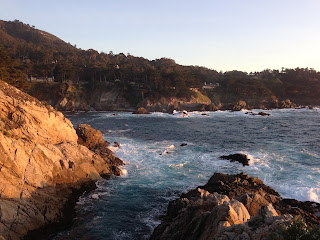
 The Atlantic, in my mind, has partially taken over from The New Yorker as a source of long form journalism.  While their political tendencies are almost always to the left of where I am - many of their writers post articles which make me think.   Conor Friedersdorf serves as a "California" correspondent.  In a July 21,2021 he wrote a piece called The California Dream is Dying which argues that California has become an ungovernable, unlivable mess.  He makes a strong case.  When I sent the article to my daughter , Emily, she commented that the analogy offered actually might well apply to the US.   (The picture by the way is was taken at a friend's house in Monterey - he is one of those Californians who has been marvelously successful in the tech industry - he worked very hard to be able to get that place AND he provided a real benefit to tech users in the area in which he worked.  But Monterey is often used as the image for California in part because of its beauty and the ruggedness of its coast.)

The first chapter of the book I am writing (Of Course It's True Except for a Couple of Lies) has a first chapter about an ancestor who came to California in 1849.   But it also reflects many things about the California I grew up in. (In the 50s and 60s).   It was a state that was cocky.  In California the Great Exception, Carey McWilliams gave a mostly optimistic view of the state but was also credited with identifying some of the warts.    In 1973, Kevin Starr, who later became a friend, began a series of books about California's intellectual history.  In the initial volume, Americans and the California Dream, covered some important figures between 1850-1915.   Many of the key figures Starr covered are now often forgotten and many others had lives that were more important than other places - take Jack London for instance who is probably more famous for his Klondike exploits but who lived in Sonoma county and helped to shape that area.

After the WWII the state exploited some key resources including several great universities  - a dean at one (Stanford) who understood the dynamics of linking industry to an engineering school; a research institute (CalTech) which worked in a number of areas at the frontiers of knowledge and technology; a public university (UC) that was constitutionally protected and thus able to develop world class programs in a number of other areas; and a university which was one of the founders of the field of public administration (USC).  Californians were, as opposed to their counterparts on the east coast more prone to accepting risk and less fearful of losing it all and then recovering.   The mythology around all this infused the air.

When I was about 14 our family went to Edwards Air Force Base for Armed Forces Day and watched a series of demonstrations including one I remember still where a rose was dipped in liquid nitrogen and then broken like glass.

But then came the 8s.   In 1958, the senior senator from California forced the Governor to switch their re-election bids (Knowland wanted to be governor so he forced his GOP colleague to run for the senate and both lost) and the employer community over-reached with a "right to work" initiative which was defeated by pretty stiff margins.  The new governor was from San Francisco and established a political dynasty - during his time he expanded the University system, built the California Water project, and initiated a long series of other public projects.  By the end of his second term, he tried to run for a third (only done once by Earl Warren) and lost to Ronald Reagan.  The late 50s also brought a series of new legislators including the ascension of one Jesse Marvin Unruh who transformed the work of the legislature.  One of the odd things was that Unruh and Pat Brown fought a lot.

The next 8 was 1968 - the middle of the "summer of love" in San Francisco - which was emblematic of all sorts of societal disruptions going on in society - much of that started in California.  "Peace, love, dope" became a mantra for many - but there were also a series of bizarre events some of horrific proportions.  By 1968 California was more balanced in its politics but the state also had a series of real nuts (one wit said it had become the "Granola" state because after you sorted out the fruits and nuts you were left with the flakes.)

In the middle period between 1968 and 1978 the state suffered through a "mystical" governor (Pat Brown's son).  During that period that state began to move quickly.  Several laws were passed which changed things deeply - the most important one was the ability of public employees to bargain and (now at least somewhat diminished) the ability of those same unions to force employees to fund political action committees run by the unions.  

But then came 1978 and the passage of a landmark initiative which limited property taxes.  The legislature fiddled with rising property taxes for about a decade and with Proposition 13 - the voters took charge.  We went through a series of initiative campaigns which attempted to reset policies about taxes and a host of other issues, some failed; some didn't. Some made sense (for example indexing the income tax and eliminating the estate tax) some did not.   While the GOP established a majority in the Assembly for a short period, they became increasingly irrelevant.  The state benefitted from several GOP governors (Deukmejian and Wilson in particular) but the conservative side of the ledger diminished.

Beginning in the second decade of this century people began to flee the state.  That resulted in two things.  First, California's ranking of residents with BA and higher declined; the state is ranked 34th among the states.  But as importantly 38% of the outmigrants from the state in the last decade have come from individuals earning more than $100,000 (the rate is even higher as you go further up the income scale).  Los Angeles was only behind New York in the number of residents leaving the area.  San Francisco, which from 1850 to 2000 had a pretty steady rise in population began to decline.  With a series of odd laws the city began to experience leakage.   Little wonder.  With the leaders concentrating on things like eliminating the legal penalties for defecating in the street, and at least passively tolerating homeless camps, and having prosecutors fail to prosecute shop lifting for items under $900 - the civility of the place deteriorated.  

California has always been a place of income and wealth divergencies.  (think the Hearst Castle built in the depths of the depression).  But in recent years those differences have become more stark.   A good way to get an idea of these trends is to a) Drive from the Bay Area down the center of the state.  Or drive in many large cities in California and travel from high income to the homeless encampments.  

The trend in California, seems to have been replicated in other cities in the country.  But there are some slight signs of hope.  Recent statements by the mayors of San Francisco and Chicago made movement in the right direction by suggesting that some of the looney laws were about to change and that prosecutors who wanted to change laws by ignoring them would be less supported.   What has not changed especially for California is the dogmatic adherence to legal structures like our NIMBY planning rules which impede construction of new housing and allow groups like the LA teacher's union to over-rule common sense on educating kids.

OF COURSE ITS TRUE - My editor has just sent me the final chapters in the book.  The next steps will require some new skills.  I want to have about 75 photos in the text and I will need to make sure the photos have enough pixels to be printed.  I will also engage a design guy to take the text file and format it correctly.  Because the book is divided into three staves (volumes) I will need to collect ISBNs (International Standard Book Numbers) so that each of the staves and the digital and paperback books will have one of those unique identifiers.   There is (finally) light at the end of the tunnel; and I am relatively convinced it is not a train coming from the other end.

Friday, November 19, 2021

 Perception is 9/10 of the law....


I rediscovered a book which I first read in graduate school about the use of numbers in public policy debates called Damn Lies and Statistics by Josh Best, a University of Delaware Sociologist.   Best's book argues that statistics are essential to discuss things we want to solve in the public 
arena AND that because so many people accept, often without question, numbers offered by public figures, newspeople and social media gurus - we live with a lot of bunk.

Let me offer one example that he offers at the start of the volume.  Some unnamed PhD candidate who had the good fortune to have Best on his guidance committee. The candidate made the absurd argument that the number of child murders had doubled every year since 1950.  Think for a moment about the power of numbers.   1 becomes 2 becomes 4 becomes 8 and so on. (at 10 days the number is 512, per day)  In a very short period the number of annual childhood murders would be will beyond the number of children and perhaps very soon larger than the world population.   The student's gaffe was not caught until a scholarly journal had published part of his research.

The problem we face with numbers is that some people are either careless or malevolent with numbers.  All of us who have practiced in the public arena have been guilty of a bit of balderdash with numbers.  In the early 1970s I worked for a Michigan congressman who was a moderate environmentalist.   (That was when such things were possible.).  He had a constituent from Ann Arbor who had a summer home in Minnesota near Silver Bay on Lake Superior.   A company called Reserve Mining extracted low grade iron ore by crushing the ore into a slurry and then extracting out the iron.  The company offered jobs to people in the area but the remaining gunk, without the ore, was held in some holding ponds and then simply washing into the lake.   The pictures of the spillway were dramatic.

We were sitting around one night and wondered how much effluent was being dumped into the lake.  I was tasked to figure that out.  We knew the depth of the sluice and its width and the approximate speed of the water.   We made some assumptions about the carrying capacity of the water and Voila a statistic was created.  The other Voila was how quickly people of authority began to quote the number.  The basis had no real justification except a (poorly) educated guess.  Eventually Reserve Mining was closed down, in part because of that bogus number.   Lake Superior is exquisite and had Reserve gone on for (a very long time) while it would have become less beautiful.

Made up statistics are frequent.  For example, Mitch Snyder once claimed that the number of homeless in the US exceeded 3 million people - the Reagan Administration did the numbers and suggested that it was closer to 300,000 and Snyder immediately claimed that the number was reduced because the Administration wanted to deny the problem.   For me that was one of the first examples of "fact" shaming.   Similar outlandish numbers came up in all sorts of other policy debates - at one point the estimated number of deaths from anorexia in young women was claimed to be 150,000 annually - that number is highly dubious but the advocates were trying to push a point.

The good point about rediscovering this book is the clear way that Professor Best describes the terrors of statistics.  He has several "hazards" for stats - they can, like my effluent stat (yes indeed it was effluent!) be made up.   Others may consider apples and oranges.   And still others can be intentional distortions.   The book was written before there was much cable news and before social media were here - but he points out that even when the book was written many reporters are simply too lazy to chase down wild claims and many may be too innumerate to understand the implications of what they bandy about.   The problem is that many people listen to the "experts" babble on about some number and believe it may have some basis in fact - and indeed, sometimes it does.   But often a number is just a close cousin to luncheon meat.

We've heard all sorts of numbers behind the Administration's Build Better America plan which has a cost of several trillion dollars ($1,000,000,000,000 - a trillion is 12 zeros!) and even those estimates are bogus because of the bizarre way costs are estimated. Don't believe the number used in the House debate - it has so many tricks and dodges it might even be called slight of hand.  I was amused a few days ago when Senator Sanders grumped that journalists have not done a good enough job selling this boondoggle.   Perhaps another explanation is that a good number of us are skeptical of a massive expansion of both the deficit and mucking around even more deeply in our lives.  Last time I checked the Press is not supposed to be a mouth piece for any administration - but Sanders thought because he was for it, the forces of political correctness must defend the point - no matter how bogus.

SO what about the picture?  One fraternity brother was driving through a small town in Mono county and saw the Chevron prices for gas. (IN the Eastern side of the state - think REMOTE).  Another fraternity brother commented "Incredible gouge. Way over prices here in Oakland."   My immediate response was to question whether the huge increases in Federal debt and the Biden Administration's attacks on all forms of fossil fuels might have created this pricing spike.

But as you think about both of our reactions - they involved a lot of jerky knees.   Here are some other things one should think about.   First, Mono county is remote - their gas prices are always way higher than in other parts of the state which are closer to refineries.   Second, as we have come out of COVID lockdowns more people are driving thus putting more demand pressure on gas prices. California especially has artificially curtailed supply.  Third, the Year to Year increases between urban Oakland and rural Mono County are not the same - Oakland's gas prices have jumped 60+% over the last year while Mono's have grown only about 11%.

Understanding how things interact is tough.  This gas thing made me think a bit about being  more cautious in responding to images or posts.   Not a bad lesson.

UPDATE ON Of Course It's True, Except for a Couple of Lies - The book is now tripartite; the first on Family; the second on Life; and the third on Beliefs.  They will be published simultaneously - and will be roughly the same size.   The first "Stave" has been done in final edit and the next two are progressing.   Based on the amount of work left to do it will probably be available in Q1 2022.


Friday, October 15, 2021

Social Media and Me

I have been struggling with a problem where I hope Five Cent Thinking's readers will offer some advice either as a response to this post or via my normal email.   NOTE #1 - As the owner of this blog I have control over what appears here; so if you want to respond but not publicly please put that in your response and I will not publish your comments.

I joined Facebook in its early stages(2004), at the time it seemed like an interesting platform which could provide two benefits.   First, as someone who spent a career working on public policy issues I thought it might be a place to participate in engaging discussions about key issues.   Second, it seemed like a way to communicate with friends and acquaintances many of whom I have not been able to keep up with over the years.

About the time I started being on Facebook I also set up a Twitter account.  But I have never used it much, if this blog has proven anything, I am not prone to short form writing!   But part of my aversion was based on the need to not react to events instantaneously.  

I continuously avoid watching any of the cable channels because of their absurd need to fill every waking minute with "news".   I first recognized the trend when I was coming back from a trip to Mexico at the time that Princess Diana died (1997).  My Spanish at the time was much more limited than now but even without understanding all the words, I noticed a pattern of commentary and images that I found disconcerting.  

Soon after I joined FB, a friend who I knew from both politics and because she was a doctoral student at SC when I was there, invited me to join a group of political types her dad had created (but this time the group was digital).   I knew a lot of the people in the group and  met some interesting people through it. The politics of the group was diverse.  But the "Wheelspinners" deteriorated after a couple of people on both sides of the political divide substituted invective for argument.   In a valiant attempt to continue the positive notions from the original group it revived it under a new name.  But that also deteriorated somewhat quickly.  

One consequence for me, if I decide to leave FB, is that I will no longer be able to exchange  insights with the half dozen people on the group who constantly help me understand nuances on a wide range of issues.  In the time I have been on FB I have been periodically surprised by a someone's different take on something I had thought quite settled.  In the Bismarkean sense part of the "politics is the art of the possible" for me is the ability to consider all sorts of options.

Both Facebook and Twitter seem to fit what a good friend in Sacramento used to call Kabuki politics.  We watch contending sides put on their makeup and join the political fray with masks or makeup on - not wanting to contend but more wanting to engage in stylized discussions where the genuine opportunity to think about things in new ways is scorned.

Let me add that I believe that the key people at FB and Twitter have absolutely no scruples.  They have consistently censored substantive ideas which do not fit their worldview.  

From my perspective the country needs to have some reasoned debate about a lot of issues including (for me)  the big four of 1) Climate change, 2) Wealth and Income Inequality, 3) Racial Reconciliation, 4) Fiscal Policy (come on, when one wrote his dissertation on Tax Theory that one is essential).   But serious discussion does not seem to be forthcoming.  You are not a "denier" or a "deplorable" because you have a different understanding of both the nature of a specific problem and the best way to handle it.

In my mind the current system of identifying political leaders is not serving us well. When I started in the political arena there were politicians on both sides of the aisle that I admired.  Now the number of politicians in that group from either party is very limited.   IF you believe that in at least the last two presidential elections we had what David Halberstam called the "best and the brightest" as the standard bearers for either party, I guess we are going to have to disagree.   Dick Tuck, who was a thorn in Richard Nixon's side for a good part of his career had the great quip that the "lesser of two evils is still evil" (I know that many attribute that to Jerry Garcia) and I think in trying to defend our choice for President that we ignore that maxim.   

For the last year and a half, the country has devolved into discussions which I believe have been structured to evidence virtue signaling rather than exchange of views.  I will admit that I can get on a high horse too.  But quite frankly, I am tired of engaging in these kinds of yammerings.  As long as we are relegated to retreating into tribes, we won't make progress in discovering the best of options.

A bit more than a year ago, a good friend who had been a distinguished college president and a keen analyst of our political environment posted on Facebook that she was leaving it.  She is a certified FOB (Friend of Bill) having gone to law school with both Clintons.  She actually taught a course with an economist of my persuasion in the Claremont Colleges.  I would have liked to been able to audit the course.  I am sure it was a good set of exchanges.  When she announced her intention to dump FB I wrote her (outside of FB) about the decision.   She replied that the cost of participation in FB far exceeded any benefits.  Over the years I have had some superb discussions with her about a wide range of issues.  We often do not agree on solutions but the exchanges have been fun.

About a decade ago a Georgetown computer science professor, in his blog Study Hacks offered a simple equation to discern the value of technologies - “ Technologies are great, but if you want to keep control of your time and attention have the self-confidence to insist that they earn their keep before you make them a regular part of your life.” FB fails on that equation.

One final comment;  an obvious solution would be to use the Wildavsky Maxim (Aaron was a professor at UC Berkeley) He quipped that politicians should "NO, thyself" - so I could simply quit responding to political posts. Quite frankly, I am pretty sure that would not work for someone who spent more than 4 decades working in the vineyard of politics.

So here is the ask.  I am thinking of dropping Facebook by the end of the month.  Here are my three questions.  1) do you have any thoughts about stepping out of social media?  2) For many of my buddies on Facebook is there a good way to stay in touch without FB? I really do enjoy hearing about families and trips.   3) Do you have any other suggestions about how someone who would like to continue to discuss public policy issues can do that in without being stuck in the mire of virtue that both sides of the spectrum try to hold us in?

NOTE #2  - If you do not have an Email address for me (outside of FB) and want to communicate privately or simply stay in touch after I leave FB,  please use messenger and I will get back to you.

NOTE #3  - On October 4, Facebook went down and Joanna Stern - the ACE technology reporter for the WSJ had suggestions for getting your data from Facebook and ideas for alternative platforms to use to stay in touch.   If you do not subscribe to the WSJ - send me an Email and I will send you a Pdf of the article.

NOTE #4 - And I realize this might sound contradictory.  Even if I dump Facebook - I will continue to use the FB product called What's Ap - it is an essential, and at least for me, non political tool in Mexico.

Friday, October 1, 2021

 E Pluribus Meum

We went to Costco this week to pick up some things - Costco has upped their game with great fresh fish (like Steelhead) and Prime beef and even great veggies and fruit and they still have monster proportions of many good products.   Plus we wanted to get toilet paper and paper towels.   Evidently, after a local news story claimed paper products were under pressure, the hoarders descended  and cleaned out every Costco in the area.   The story also mentioned  that water was facing a run and indeed we encountered a woman with a basket full of about 10 40 bottle packs of water.

We seem to have lost sight of one of our founding principles - E Pluribus Unum - which is based on the idea that we have some common principles that bring us together.   I am not a complete pessimist on this problem - there are counter examples.   But the trend line based on the amount of me first, is troubling.

The same afternoon, while Quinlan was going to pick up a prescription, she found that booster shots were available, so she got hers. No line.  By the time she got home and got me back there a substantial line had formed.  But she dragged me back and  I had to stand in line for almost an hour.   The line was convivial.   Each of us waiting patiently (no pun here!) to get the third stab.  One lady ahead of us was much older than we and a couple of people found her a chair while she waited.  So in spite of our Costco experience we got some hope from the booster line.  I began to think about what has caused this seeming increase in selfishness.  I came up with three possible types of people who might be likely to be ignoring our interrelationships  - (these are presented in no order) ....

1) Those who immigrated to this country from despotic regimes.  This is not a statement about immigrants - the American tradition of welcoming people who want to join us is a good one.   We benefit from their contributions.   But those who have had to live under totalitarian regimes understand the absolute irrationality of them and they have had more experience negotiating with scarcity.  One of my favorite movies is Robin Williams’ Moscow on the Hudson.   It tells the story of a Russian circus performer who before he defects at Bloomingdales is forced to wait in line for everything - he accepts a pair of shoes which don't fit because that is the size they have. He can trade the ill fitting shoes for some other favor.   Before he defects he celebrates with his family because he was able to stand in line for toilet paper.   When Paul Mazurzky wrote the script I am sure he did not think that snip would become prophetic almost 40 years in the future.   When the circus performer defects to the US he is confronted with the range of choices and a lack of lines.   At first he dislikes all those choices.  But he soon learns that with freedom comes sometimes daunting choices.

But again there is some reason for hope - in the University board I chaired for seven years we heard from a student.  He was a physician from Venezuela and told a compelling story of his flight from his country.  He did not have a  chance to "pursue happiness" in his own country as totalitarians destroyed a vibrant economy.  So he came to the US.  Even though he  could not get his transcripts from his home university and is now working on a degree as a Nurse Practitioner.   That kind of initiative is something we should celebrate!

2) Those sucked into entitlements.  Entitlements are those programs where eligibility is not limited - you get the benefit often without a demonstration of need.  Student loans are a good example of the risks of entitlements.   Students who need to borrow (or want to borrow) for their education can use a number of programs which provide subsidized rates and terms.   In this case, when the Obama administration took over the programs (which previously had private sector participation), and transformed loans into a program run by the Department of Education - the number of loans grew substantially and concurrently so did defaults.   (Reminds me of a saying in one of my favorite saloons in Stockton - they had a sign that said "We have an agreement with the bank, they don't sell beer and we don't cash checks.")  The feds proved incompetent at running the program and defaults soared.   The revision in the program was foolhardy  - in recent years there has been a clamor that a student can borrow money, default on the loan and then have it forgiven.   That creates some truly perverse incentives.   If you are entitled to one set of things - why not everything?   A few years ago at the Democratic National Convention we heard the story of a cartoon character who derived all her benefits in life from the support she derived from government.   For me at least that was a bizarre picture contrary to things which made the country great.  

 Let me offer another entitlement that is closer to me.  The Social Security Trust Fund will go bankrupt as the number of recipients is rising and the number of tax payers paying into the fund is diminishing.  The fix is pretty simple.   In 1983, some very modest adjustments to the age of retirement and the tax base, funded the program for almost 40 years.   That could be done again - but the Senior Meums think as long as they get their check they don't need to worry about the next generation.

3) Heavy consumers of social media.  When I first got back to San Miguel in March of 2020 I went to my doctor and asked him what I should do special - being a recently cleared cancer patient.  He offered all the normal things about masks and distance and hand washing but then suggested the most important health devotion was to "avoid social media."   That was good advice.   The old story of Chicken Little is one that anticipated the bizarre range of opinions that came out on Covid.   Who the hell thought that a highlight of social conversation would be about “spittle distance?”   Moral certitude and virtue signaling have been substituted for common sense.

Clearly, the threat of COVID is real.  But in reality the constant “if it bleeds it leads” for both social media and cable news has diminished our ability to separate the real horribles from the imagined ones.

What concerns me is that we’ve seen a huge increase in a perspective which does not serve us well.  

So what are the consequences of moving from Unum to Meum?

The Meum world is very close to what Hobbes described in his description of life as "cruel, brutish and short."   The Meums look at the world as a zero sum game - if you get something I am deprived of it - so there is every incentive to get mine NOW.  In my mind, positive sum games are closer to reality.   If that is the case we should think about ways to devise methods where if each of us contributes a bit we are all a lot better off.   Cass Sunnstein and Richard Thaler wrote a book called Nudge which tried to tease out the implications of this type of thinking.

If we do not turn back from Meum, we will be following a sad path divided into warring tribes with an increasingly narrow range of choices.  That seems both sad and stupid.

Update on the book ----- This week my editor got me a final draft to work on.  My next step is to get a copy editor to clean up the draft and then to get the final to a publisher.  I've also retained a design editor to make the manuscript fit into the constraints of publishing.   The good news is that almost anything that traditional publishers once did can be done in the DIY world with very seasoned professionals.  I spent some time this week on Reedsy - which is a great site which has tons of resources for authors.   I attended (ZOOM) a seminar to learn about the range of alternatives to print and distribute books.   There are some exciting options from Amazon and Apple Books - to Ingram Spark - which actually can print on demand AND can help new authors distribute their work.  Like other parts of the economy the web has forced a very hierarchical business model to change.  That has democratized the process of creating a book.  The complexity for me is that to be effective I need to tread through these elements to get to where I want to go.   I hope to have a copy editor identified in the next couple of weeks; have my final edits to that person after that and then get this project into production.   One of the best pieces of news I got from the Reedsy Zoom meeting (led by an author who has done traditional and DIY publishing) is that the DIY world, once you understand the elements is much quicker.   The Author had a  book which went to his traditional publisher at the beginning of September and expected to go into print in Q3 of 2022 and his DIY book should be in bookstores and on the web by the end of November.   That is quite a difference.


Saturday, September 4, 2021

In Quest of Conclusions

So this week was a momentous one.  I sent a final edit to my editor.  Well, as you may have noticed final in the publishing world is a lot like many other finals in life. I will come back to the book at the end of this post.

This week our president, finally pulled us out of Afghanistan.  That was a conclusion I believe that most Americans thought was appropriate.   There was an uproar on his lack of consultation with our allies and his “strategies” (I believe both were justified in spite of the need to leave) to withdraw.  The chaos at Kabul airport was horrific.  I think if one is charitable this was not the USs finest hour.   But we are out of this 20 year involvement, or are we?   Babylon Bee joked that the Taliban had opened an Army surplus store with all the military equipment left behind.   For me I am more concerned about the people we left behind.   News reports are that the Taliban has not treated those who helped our effort but could not get out well.  One wag described the evacuation as a Blunder-Bus.

From my perspective the  lessons we should learn from this - which we do not seem to be very good at -a) is to follow one piece of advice my mother gave me - "Just because you can doesn't mean you should" and another which suggests that if you don't have a pretty clear plan when you get into something you are not likely to succeed (if you fail to plan you plan to fail).   In several instances of foreign policy in the decades since WWII - we have violated both rules and paid the price.

It turns out that Sacramento will be a large venue for the Afghani refugees who were able to get out ,many of whom worked in support of the American mission(s),  And in one of those odd turns of technology - we got an appeal from a friend in SMA (a former State Department employee) who worked with an Afghani who worked for the American Embassy (and she had worked with) who will be coming to Sacramento.  Soon after we got that, our Priest in Sacramento convened an interfaith meeting to think about how we could help these people as they are resettled to our area.  IMHO that is the least we owe them.   At the meeting we heard from a couple of remarkable people who have helped to coordinate including one amazing woman who is in charge of collecting and distributing food and other kits to new arrivals.   Her husband commented that their lawn is a bit shaggy because their garage is full.  Two local charities The Rescue Center  and the Sacramento Welcome Center seem to be working hard on accommodating our new arrivals.   At the meeting we had Episcopalians, Latter Day Saints, and Muslims represented.   It was heartening.

But then we are also coming to a conclusion on the Recall effort against Governor Newsome.  The polling at this point seems to be going in favor of retaining Newsome.   As often happens in the last two weeks before an election there is an awful lot of hyperbole being thrown about.  The leading candidate to replace the Governor has had a bunch of wild charges made against him.   But then you look down at the choices that Californians are being offered to replace the Governor and you don't need to wonder why the state has a flaky reputation (even if we did not have a Governor who in the middle of the COVID lockdown chose to have an unmasked dinner at a fancy restaurant in Napa which one of my democrat friends charitably described that action by Newsome as “tone deaf”).   The range of talents is quite limited while the depth of aspirations is mind-boggling.  Well actually the talent is in short supply. Perhaps four or five of them could actually do the job.  As one long time democrat campaign guy said, skills here should not be considered.  If the governor is recalled the sages in the legislature are likely to greet the budget proposal with two words “and those are not likely to be Merry Christmas” - as a native Californian I would wish that we could get a group of us who could get off the Kabuki politics we’ve lived through for the last couple of decades and begin to tackle issues like homelessness, water, improving the schools and things that really matter to Californians.  

The fire season also started early this year and much of the Northern part of the state has enjoyed AQIs (Air Quality Indexes) of well over 200 for several weeks.   Not to make a bad pun but we are not out of the woods yet.   The combination of terrible forest management, idiotic water policy combined with whatever effects their might be from climate change offer real risks through the next couple of months.  The good news, to the extent there is some, is that most of these fires, so far, have not produced significant damages to homes like the 2017-18 fires did.   When we left SMA the AQI there was 28; when we arrived in Sacramento it was 226.  I don’t think anyone can tell you when we will be out of this fire season or more importantly when the “leadership” of the state will be inclined to tackle the real issues that leads us to move to “smoke without mirrors” in each of the last half dozen summers.   Presented at the bottom of this post is a primer on AQI.  

One other odd comment about disasters.  Are you as puzzled as I am about the news coverage on Ida?  The number of deaths as a result of the 2005 storm Katrina was more than 1800 - this year in the south is is fewer than 5.  Sure power went out.  But because of a new system of levee reinforcement since Katrina hurricane alley was relatively safe.  Compare that the the news coverage o deaths in the northeast (46) where the coverage has produced comments like this from the AP "A stunned U.S. East Coast faced a rising death toll, surging rivers and tornado damage Thursday after the remnants of Hurricane Ida walloped the region with record-breaking rain, drowning more than 40 people in their homes and cars." (Yes I did add emphasis)

The AP goes on to comment "In a region that had been warned about potentially deadly flash flooding but hadn’t braced for such a blow from the no-longer-hurricane, the storm killed at least 46 people from Maryland to Connecticut on Wednesday night and Thursday morning." If you ever wondered about the regional biases of the MSM - look no further.


SO what is going on with the book?  As noted at the start of this Ramble (the apt name of my original blog) a final draft went to my editor this week.  But what does a “final draft” actually mean?   First, I have two chapters still out with reviewers.   The comments I have received on all the other chapters have been stunning; very very helpful.  For example, in the chapter I did on Values - a good friend helped me understand that the Bible does not mention luck.   He commented that if God is either omnipresent or omnipotent he does not get surprised - but humans do.   Second, I have spent some time working on photos.  A key part of this project for me has been to include photos.  But there are some quirks in getting photos printed.  As noted in the last post, they need to be of a high enough resolution to be useable.  But I may actually be able to use color photos in the Kindle/iPad version but will probably need to use black and white photos in the paperback.   Getting those organized for my design guy is a bit of a task.   Third, one of my sources offered me two dozen publishers who can get something into a paperback edition.   Over the last two years I have consulted with some of those but there are still half a dozen leads to run down from Kindle Direct to a bunch of smaller presses.   Finally, there are two unresolved issues in the manuscript.   My editor suggested that I include a visual timeline at the end of the chapters on Family.   I do not like what I came up with (visually) and I may just leave that up to my design person.   But there is also one chapter that I am still undecided on whether I will include it - which originally came when this was a Storyworth project. It is a musing on my reading habits.  I’ve already cut several chapters (ones on Critical Race Theory - called Plessy v Diangelo - which I liked and my reviewers also liked; on on how I dealt with COVID; and one on media influences when I was a nipper which was restructured to a speculation on whether I am a person of my times).   My goal is to get comments back from my editor by the end of the month; spend some time in early October doing final final revisions; get the manuscript to the design person so that by about the first of November we will begin to getting the project to final publication.


As I was researching the book I re-read Huckleberry Finn and came across his epithet for his book  “so there ain’t nothing more to write about, and I am rotten glad of it, because if I’d a knowed what a trouble it was to make a book I wouldn’t a tackled it, and ain’t a-going to no more.”  Who knows whether I will follow Huck’s standard.

What is the U.S. Air Quality Index (AQI)?

Think of the AQI as a yardstick that runs from 0 to 500. The higher the AQI value, the greater the level of air pollution and the greater the health concern. For example, an AQI value of 50 or below represents good air quality, while an AQI value over 300 represents hazardous air quality.

For each pollutant an AQI value of 100 generally corresponds to an ambient air concentration that equals the level of the short-term national ambient air quality standard for protection of public health. AQI values at or below 100 are generally thought of as satisfactory. When AQI values are above 100, air quality is unhealthy: at first for certain sensitive groups of people, then for everyone as AQI values get higher.

Daily AQI ColorLevels of ConcernValues of IndexDescription of Air Quality
GreenGood0 to 50Air quality is satisfactory, and air pollution poses little or no risk.
YellowModerate51 to 100Air quality is acceptable. However, there may be a risk for some people, particularly those who are unusually sensitive to air pollution.
OrangeUnhealthy for Sensitive Groups101 to 150Members of sensitive groups may experience health effects. The general public is less likely to be affected.
RedUnhealthy151 to 200Some members of the general public may experience health effects; members of sensitive groups may experience more serious health effects.
PurpleVery Unhealthy201 to 300Health alert: The risk of health effects is increased for everyone.
MaroonHazardous301 and higherHealth warning of emergency conditions: everyone is more likely to be affected.


Sunday, July 25, 2021

Back to the Book

When last I wrote I discussed an increasing tendency to be super cautious.   This post is different.  You see, I've done a couple of things in the last two weeks which I think are progress.   First, I completed the final chapter in the section on philosophy - that is focused on values.  It proved more difficult to write in part because the subject  is not an area where I have spent a ton of time studying the issues.  The ratio of economics and finance books and articles in my library to religious texts is perhaps 879:1.   (That is not because I only have 879 books on finance, economics and tax issues.).  I sent it to three friends more qualified than I to look at the draft.

Second, I got out the conclusions chapter which I finished almost a year ago.  The opening meme (A glass is neither half full or half empty but refillable) is still on point.  But believe it or not since I got that first draft done my thoughts have modified, a bit, in many areas.  Writing a book like this is an iterative process - and thanks to the people who have read chapters also an interactive one.   So I have begun to redraft that last chapter.

Third, then there is Filomen.  One Sunday night two years ago as  Quinlan and I were going out to dinner with some friends  we encountered a burro parked on the street, standing there calmly.  I thought the photo was evocative of many issues raised in the book and thought it could be a perfect cover photo.  I went to the guy who is doing design and he said my photo was a bit thin. (Not enough pixels). So I tried a bunch of techniques but could not get to the density needed.  So I called a bunch of friends in SMA who gave pointers to the Burro Guy in SMA (Armando Rivera).  I found him, talked him into coming up to the original site of the photo. He spends many Sundays with Filomen posing for pictures around the Centro.  He noticed my facemark and remarked "Tu cubraboca es Filomen!" (Your mask is Filomen).   We walked up - I shot several pictures.  They may not be enough. If not I will ask him again to help me so I can shoot one more shot in RAW image. (Which is 25 Megapixels).   When I started this project one friend told me based on his experience of writing a book - that at one or more times you will become obsessed with a detail - either running down a fact or something like this photo.  Ok, so that obsession thing seems to have passed, for now.

Fourth, a book written by two friends came out this week, called Mitka's Secret, which is about Mitka Kalinski. At the beginning of WWII Mitka was orphaned from his parents and then spent all of the war either in concentration camps or as a slave of a Nazi sympathizer.   He then spent a couple of years in post WWII relocation camps and eventually was relocated to the US.   He started in the East, married and then made a life in Sparks, Nevada.  He never learned to read and write.  But he worked hard and became comfortable retaining an indomitable spirit.   The book is hard not to read it in one setting - It is an inspiring story of the indomitable human spirit.  Mitka's Secret has a much different focus than Of Course It's True" but it showed me there is light at the end of tunnel.

Finally, beginning next week I will go through the entire draft one final time before sending it off the my editor and the designer.  With luck, Of Course It's True Except for a Couple of Lies (Por supuesto que es verdad, excepto por un par de mentiras - if there is ever a Spanish version), will be in print by the end of the year.